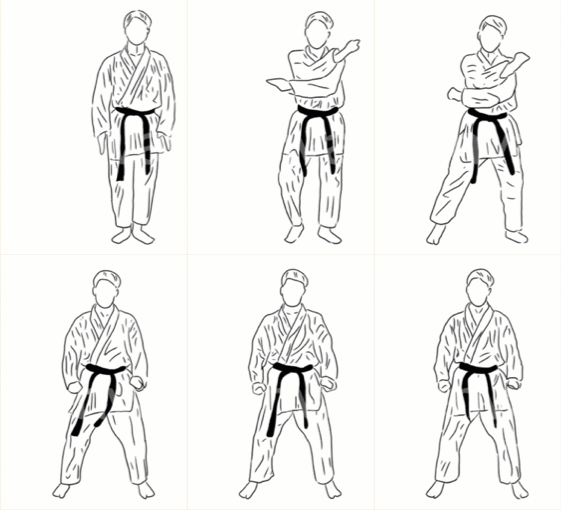
At Least Eight of the Following Vital Spots of the High Section
Windpipe
Eyeball
Temple
Skull
Nose
Lips
Occiput
Mandibula
Upper neck
Neck artery
Jaw
Point of chin
Bridge of nose
Philtrum
Forehead
Adams apple
Angle of the mandible
Mastoid
At Least Eight of the Following Vital Spots of the Middle Section
Radial artery
Shoulder joint
Elbow joint
Umbilicus
Epigastrium
Sternum
Clavicle
Thenar
Heart
Spleen
Liver
Solar plexus
Floating rib
Wrist joint
Back wrist artery (on back of wrist)
Kidney
Armpit
Cervix
Upper back
Small of back
At Least Eight of the Following Vital Spots of the Low Section
Inner thigh
Tibia
Instep
Knee joint
Groin
Scrotum
Coccyx
Fossa
Achilles tendon
Pubic region
Lower abdomen
Ankle joint
The Eight Characteristics of the Ideal Instructor
Strong moral and ethical standards.
Clear outlook and philosophy in life.
Responsible attitude as an instructor.
Scientific mind in matters of technique.
Knowledge of the vital spots of human anatomy.
Unshakable integrity in political and financial dealings.
Dedication to spreading the art of TaeKwon-Do throughout the world.
Ability to gain confidence from seniors, trust from fellow instructors, and respect from juniors.
The Twelve Parts of the Instructor's Responsibility to the Student-Instructor Relationship
Never tire of teaching. A good instructor can teach anywhere, anytime, and is always ready to answer questions.
An instructor should be eager for his/her students to surpass him/her; it is the ultimate compliment for an instructor. A student should never be held back. If the instructor realizes a student has developed beyond his/her teaching abilities, the student should be sent to a higher ranking instructor.
An instructor must always set a good example for students and never attempt to defraud them.
The development of students should take precedence over commercialism. Once an instructor becomes concerned with materialism, he will lose the respect of his students.
Instructors should teach scientifically and theoretically to save time and energy.
Instructors should help students develop good contact outside the do-jang. It is an instructor's responsibility to develop students outside, as well as inside the do-jang.
Students should be encouraged to visit other do-jangs and study other techniques. Students who are forbidden to visit other do-jangs are likely to become rebellious. There are two advantages for allowing the students to visit other gyms: not only is there possibility that the student may observe a technique that is ideally suited for him, but he may also have a chance to learn by comparing his techniques to inferior techniques.
All students should be treated equally. There should be no favorites. Students should always be scolded in private, never in front of the class.
If an instructor is not able to answer a student's question, he should not fabricate an answer, but admit that he does not know and attempt to find the answer as soon as possible. All too often will a lower degree black belt dispense illogical answers to his students merely because he is afraid of "losing face" because he does not know the answer.
An instructor should not seek favors, such as cleaning the studio, doing repair work, etc., from his students.
An instructor should not exploit students. The only purpose of an instructor is to produce both technically and mentally excellent students.
Always be honest with students and never break a trust.